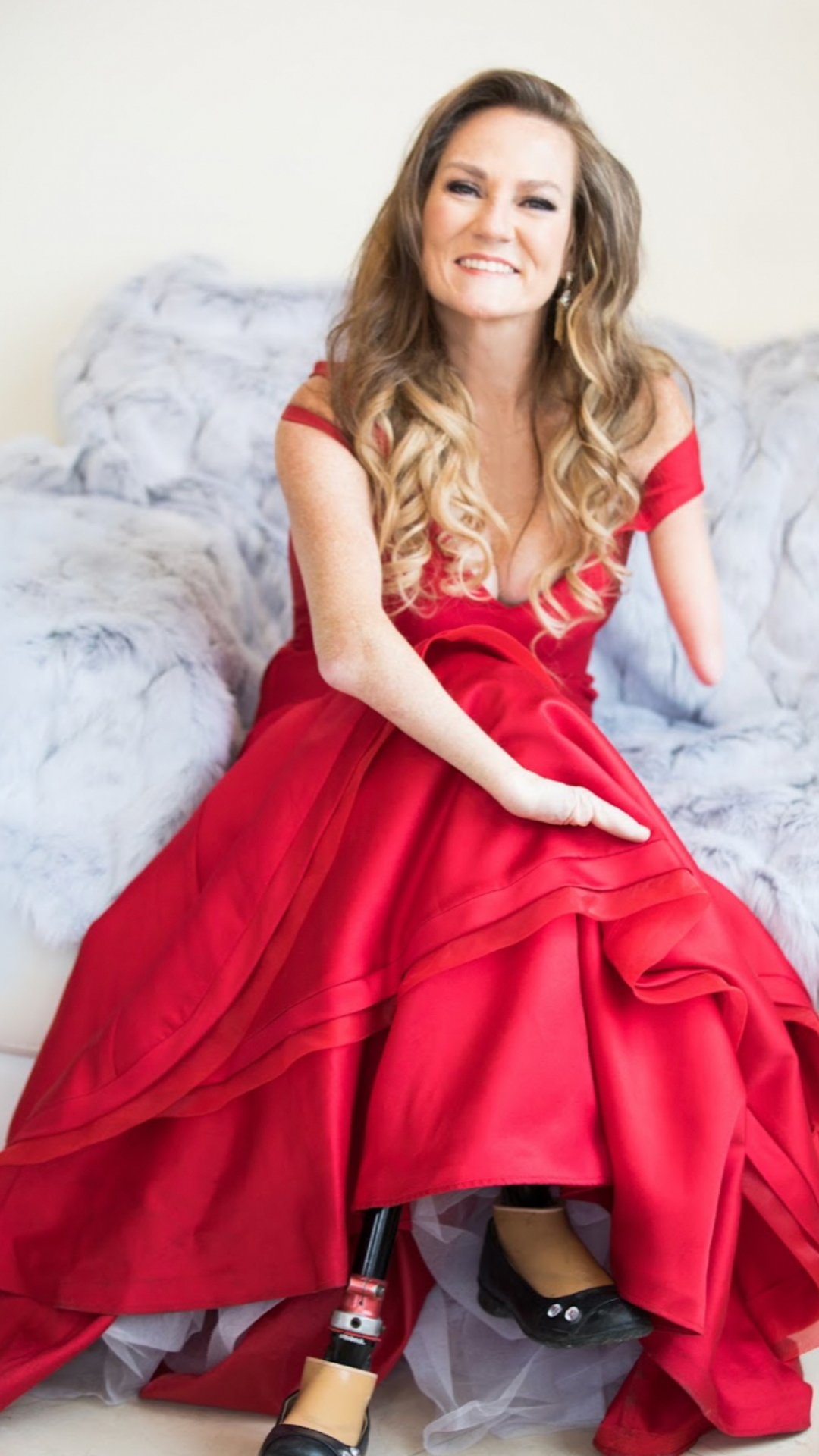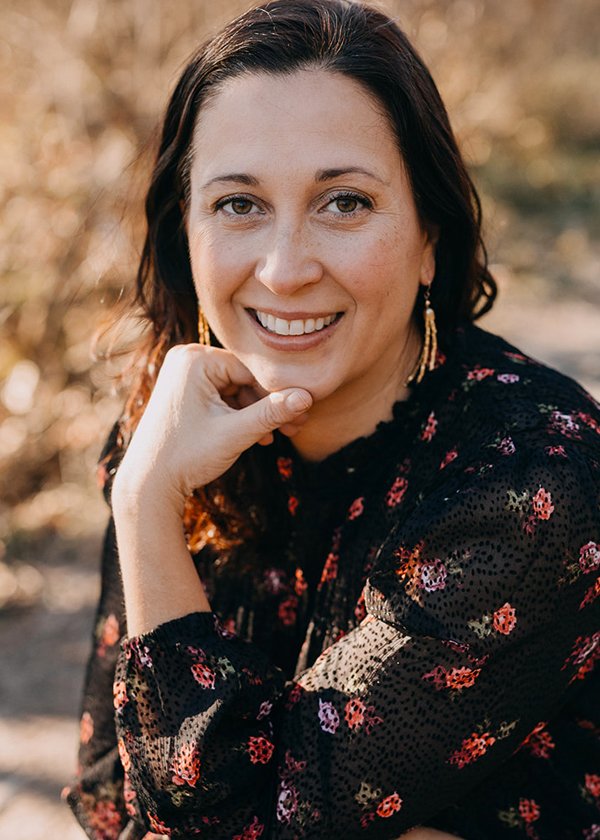

Laura Robertson, is the founder of Beautiful Potential Consulting, a beauty and branding company, building confidence and empowering women to pursue their dreams. She is also co-founder of iLocal Online Advertising and Marketing, a full service marketing agency providing a wide range of online and traditional marketing solutions.
As an Independent Certified Coach, Trainer & Speaker with the John Maxwell Group, and degree in Business Management, Laura comes with decades of leadership, coaching & training experience. Laura has worked with billion-dollar, top industry companies in corporate America as well as individual clients and business owners. Besides her advanced business skills, she is passionate about serving others and meets any issue with curiosity and a smile.
Laura came from humbling beginnings. Born into a poverty-stricken refugee camp, Thailand, spending two years homeless and displaced after her family fled the communist rule in their homeland, Laos. Growing up as a refugee in America, Laura had to overcome many obstacles. Her perseverance led her to become the strong, successful business woman that she is today. Through all of her endeavors, Laura continues to follow her passion by using her unique talents to teach, mentor and inspire others to live out their full potential!
My family’s refugee journey began when they were forced to flee the country after the communist invasion on our homeland, Laos. Between 1964-1973, the US dropped 2 million tons of bombs on Laos. During the Vietnam War, a secret war was waged on our country, making Laos the heaviest bombed country per capita. The continuous bombings over a period of nine years had destroyed many villages and displaced hundreds of thousands of civilians in Laos. The Ho Chi Minh Trail, which ran across the border of Laos, was used as an American outpost to help keep South Vietnam from advancing to the North Vietnam. Many Laotian civilians, including my father, were recruited, and trained as freedom fighters by the American troop to keep the communists from invading our country.
My Father’s Story
At the end of the war the government of Laos was very unstable. My father did not feel safe leaving my mother alone by herself while he was tending to his teaching position to provide for the family. She had a toddler, my brother Alisak, and was pregnant with my brother, Norrarak. My father decided to send her to stay with my grandparents in Ampur Wanyai Province Mukdahan, Thailand. After knowing they were safe with family, he went back to work in Vientiane.
In December 2nd 1975, Puket Lao communist took control of the country. The Puket Lao government ran under the leader, Kaysone Phomvihane. Lao communist party leader announced that they renamed the country from Royal of Laos to the Lao People Democratic Republic. They signed agreements giving Vietnam the right to station armed forces and to appoint advisers to assist in overseeing the country.
In the meantime, they took the King of Laos and his family to North of Lao and let they die from starvation. There were a lot of deaths in the Seminar Area.
After returning to his teaching position, the old Royal Government and the Puket agreed to merge together. He was sent off with Puket Lao to the North of Laos, Viengxay city, Houaphanh Province to get re-education on the new communist regime. They called it a “Seminar” at that time. He was severely tortured, not eating enough, forced to work hard without pay. He was held hostage with a tight rope around his wrists. Those scars are still visible today. He was held in captivity in a makeshift prison that was made from a bombed-out mountain.
This is the present picture of where he was held captive:
 About one year after being held in the Seminar, he and his friends were sent back to Vientiane. He disliked the new regime governing over Laos and began plotting his escape. In the end of June 1976, he escaped Vientiane with two of his friends. His friends made him a fake ID card with the name Somchanh. His two friends, Somnuk and Mone left Vientiane heading to Thakek City, Khamouane Province. His friend, Mone’s parents lived in Taseng Ban Pong, which was nearby where they were heading. The plan was to ask Mone’s father to help them escape to Thailand.
While they were waiting for Mone to find his parents, they hid in the forest. During the time that they were hiding, they encountered three bystanders that threatened to report their escape to the communist. Scared for their lives, my father shot and killed the bystanders and ran for his life. They were relieved once Mone finally contacted his father. With Mone’s father’s help, they started planning a way to cross the Mekong River and escape to Thailand. Mone’s parent were afraid their son will die in front of them while he is making his escape. They had been in the forest for five days without food and survived eating wild fruits in the jungle.
On the day of escape, Mone’s father came out to tell them that it was safe to make a run for it because the communist army were in a meeting. At this point, they had nothing to lose. They made their decision to die if something bad were to happen. When we rowed the boat to the middle of Mekong River, they decided not to cross the river in the dark, because they were afraid the Thailand border police will shoot them. They decided to sleep on a nearby island called Kaseth Island. This is where they made a commitment that if something happened, they are ready to die together.
The next morning, they pushed the boat out and found a ton of fruits that Mone’s father left. He was worried about them starving and left the fruits without them knowing. They left the island crossing over to Thailand to Ban Laonath. Once they reached the borders, they were pleading with the Thai border patrols at the village to arrest them. They refused to arrest them because they were not immigration police and did not have a car to transport them to the big city. They also said the Thai government ordered them to send anyone crossing over from Laos to return.
My father and his friends laid down in the boat and told the Thai patrol to shoot them if they are going to get sent back to Laos. The Thai patrols had sympathy and decided to help them. They told my father to continue to row their boat until they hear the police call them to stop. They did what they were told and once they saw the Police border patrols, they stopped and asked to be sent to Nakhonphanom Province. They exchanged the boat for help getting to Nakhonphanom province, near where my mother was staying.
When they arrived to Nakhonphanom province they took a taxi to Ampur Wanyai to reunite with my mother and brothers. My father had an emotional breakdown, and his heart was relieved with joy to finally see that his children and wife were still alive.
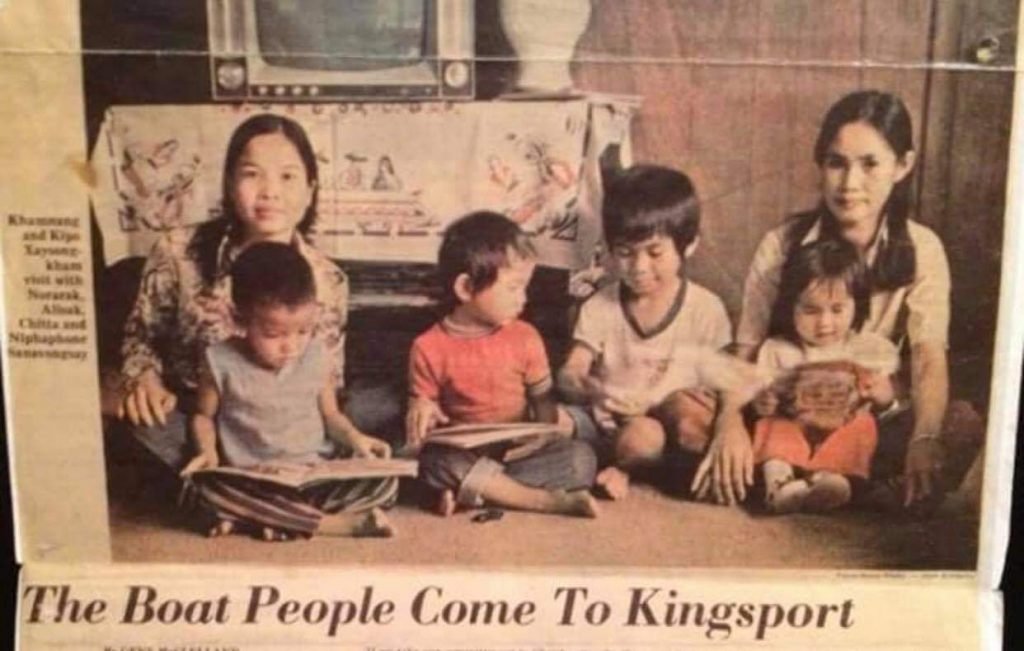
We entered the refugee camp in 1977, shortly after I was born. We were homeless and displaced and the makeshift tents were used for our shelter. We received free food from the United Nation, one meal per day for each family. My uncle worked as one of the food distributers in the camp and he would sneak us extra food when they had some. After years of living in extremely poor conditions and starvation, we were blessed to finally be sponsored by the church. We arrived on January 29th 1979 to Kingsport, TN. When we got here, we spoke little to no English. We used our body language to communicate. Many people that tried to escape were shot and killed. We are blessed to have the opportunity and the chance for a better life than what we left behind.
My Childhood Experience
When we learned that we had family in Illinois, we relocated to the Chicago suburbs. We found a small studio apartment for our family of five. We relied on public assistance as we were still poor, but we were out of the extreme conditions that we escaped from.
My early childhood experiences in America were filled with great memories. As more and more Laotian refugees found their way to America, many made Elgin, Illinois their new home. My family and I lived in a community surrounded by relatives. We survived as a community and helped lift each other up.
I remember having a happy childhood. I did not understand the meaning of being poor. We lived in roach infested homes, but I thought that was normal. My favorite memory as a child was walking down to the YWCA around Christmas time. I knew that I would walk away with bags filled with gifts and surprises. Now that I am older, I realize that those where gifts from the kind donors that wanted to put a smile on a poor child’s face.
I went to bilingual school with about twenty other refugee children and then introduced to public schools. Public school was very scary for me. I had separation anxiety from my mother. My family and I lived in a community surrounded by our relatives. My teachers had to call my mom just about every day because I would not stop crying. I would do everything in my little power to kick, scream and grab on to her while being pulled away by the teachers.
As we got older, things started to change. Many of the families started to become more stable and moved out of the area. We were still a very tight community and had many get togethers for birthday parties and events. Most weekends, we had a full house. The adults would drink and gamble while the children ran around and played. My childhood was school, home and family. My father was strict, and I was not allowed to do anything else outside of school.
Elementary was emotionally challenging for me. I was doing great academically, but I had a hard time trying to fit in. I was often bullied and harassed because of my ethnicity. The famous chant was “Chinese, Japanese, look at these!” with the bullies pulling their eyes back to make fun of my Asian descent. I wore a lot of hand me downs and clothes that my mother would sew up for me. I was often criticized for how I dressed and my off-brand shoes. I had one classmate that did the most. He would throw spitballs at me and often pulled my chair underneath me to watch me fall to the ground. I was bullied, but I just thought that it was kids being mean and had no understanding of racism at that time. I was told by my fifth-grade teacher that I did not deserve this country. When I told my dad what happened, I remember him trying to explain racism to me. He said “honey, some Americans do not like people with dark hair”. I did eventually make some friends in school.
The Biggest Challenge I Faced
Was in my pre-teen to teenage years when life started to take a huge turn for the worst. I was raised very sheltered, by traditional Laotian parents that had this false hope that I would turn out to be the perfect traditional child. That is where the conflict came in. Being raised in America, I did not know “how to” be a perfect traditional Lao daughter. My parents would stress how important school is and that nothing else mattered. I remember a time when I went bowling with my cousin. My dad found out and he came to pull me out of there in front of everyone. We were not allowed to do any extra activities and especially with boys. They often stressed that they did not want me to end up in a factory and working hard like they did.
In my earlier years I was bullied for not being American enough for my classmates. As I got more Americanized, I was too American for my Lao community.
When I got to high school I wanted to be like my friends, and I started to rebel. I did whatever I wanted to do against my parent’s wishes. I became the black sheep of the family and in my community. Many of the other children were no longer allowed to play with me. I think this isolation pushed me further away. I was skipping school, failing classes and did not care.
When I started to date outside my race – particularly black guys – I was ridiculed by selected few people of my community. At that time, the Black community was being displayed in the media as criminals and bad people. So, our Lao community also formed a bias against Blacks. I found myself being followed around in the hallways of my high school being called “Niger Lover” and “Slut”. I was being harassed at home with phone calls yelling the same verbal attacks. I was in multiple fights that I did not start and kicked out of school.
I disappointed my parents and there was a lot of tension between us. I was making stupid decisions and not thinking about the consequences. I remember the time when I took my uncle’s car out for a joy ride. I came back home, parked the car in the garage and went to bed. When my father came home with all the built-up anger from everything that I had done, he broke into my locked bedroom door and beat me up so bad I had blood clots throughout my face. My mother would also say many hurtful things to me like “I’m going to grab a knife and cut your face so no guys would look at you!” I would often hear their late-night fights and one time heard her say to my father “if I knew she would turn out like this I would have aborted her in my womb!” Whoah! The series of incidents took a very emotional tow on me as a teenager.
How I dealt with the challenge
Although it was probably not the most ideal thing to do, I overcame this challenge by running away from my problems. I was dating my high school boyfriend at the time and his step-father was transferred to Kansas City for his job. At the age of fifteen, I ran away from home and moved to Kansas City. I believe getting away into an entirely new environment helped me hit the reset button. I lived with my high school boyfriend and his family. They took me in and his mother, mama Sonja, became my legal guardian.
I was a lost Asian teenager, taken in and raised by a Black family. Initially, we lived in the suburbs of Kansas City. When mama Sonja and her husband separated, we moved to the inner city of Kansas City with her mother, Grandma Betsie. I attended an all-black school, lived in an all-black neighborhood, and had my first taste of black-eyed peas, pinto beans and corn bread! I finally found acceptance, love, and stability for the first time in a long time. This set my path at the hardest and most critical time of my life.
My turn around came in the last semester of my senior year I broke up with my high school boyfriend and moved back home to my family. I knew how important it was for my parents to see me walk across the stage.
After high school, I went to beauty school against my parent’s wishes. They wanted me to go to a traditional college and told me that I would not make a living as a beautician. I made a successful career from following my passion and not following what others have for me. My beauty school career led me into many different areas of the field including education, salon management and owner. I was in my late twenties when I ran one of the top named beauty schools in the country, managing the full operation of a two hundred sixty student campus and twenty staff under my leadership. This is when I realized I had a passion for business operations, coaching and development. From there, I worked in various fields of sales, coaching, leadership, and management positions. I found my passion to be in coaching and development. I love giving the tools to help others become the best version of themselves. That is when I became a certified coach, speaker and trainer with The John Maxwell Group.
I left my full-time position in December 2019, at the highlight of my career, to pursue my dreams. I felt this strong calling to do something more meaningful, and to use my story to make an impact on others. I am now owner and founder of Beautiful Potential Consulting and co-owner of iLocal Online Marketing & Advertising. I have a unique business model that consist of beauty services, photo studio, media room and business office all in one location. We help women look and feel beautiful while providing personal or professional coaching services. I have created a platform that will help women build confidence and to empower them to live out their dreams! I want to be remembered as the cheerleader that helped them find their potential and pushed them past their limitations. I want to make an impact on the lives of the women around me.
I believe that women have a powerful voice that they can use to make an impact. We have many obstacles that is set to hold us back. If we can empower each woman to be more than the limitations that are placed on their lives, we will be such a powerful resource for the generations ahead!
What are the Misconceptions about Refugees
I believe that the biggest misconceptions about refugees is that we were brought to America and handed a silver spoon on a platter. This is so not the case. When we come to America, if we are fortunate, we get a little help in the beginning to get us stable on our feet. We are on our own after that and have to work hard just like everyone else. We have to pursue our education and find a way to make a living for ourselves. Many of us are here because of the challenges we were placed in and the conditions of our homeland. We have left everything behind in search for a better life.
What is Humanities responsibility to those Who are displaced
The church that sponsored us had their doubts about sponsoring a refugee family because of the responsibilities that came with it. After seeing the dire needs and learning more about the conditions that we were in, it pulled at their heart strings and they couldn’t turn their backs on the opportunity. I think that the more informed and educated we are about the desperate plight of the families that are displaced, the more we will feel a moral obligation to help make a difference.